
phd031305s.gif GIF Image, 600 × 260 pixels.
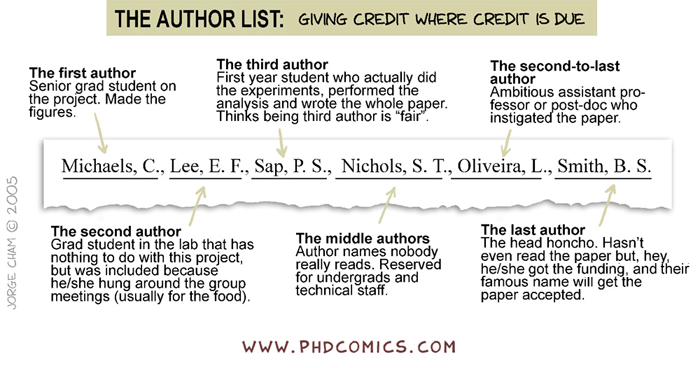
Author lists SHOULD demonstrate scholarship and the advancement of knowledge. They should NOT be about politics. They ESPECIALLY should not be about paying ‘homage’ or stroking egos.
Sadly, and, more and more, they are. I realize this is typical. That doesn’t make it right.
I’ve always thought that ONLY people who actually contributed intellectually to the paper should have their names attached.
I’ve never thought being the head of the lab should be worth publication credit. They deserve thanks in the acknowledgements. They shouldn’t be authors.
There are people who insist their name go on everything that comes out of their lab (subtly sometimes, but the pressure is there just the same). I have NO respect for those people, and neither should you. Sure, they have money to pay grad students to do work for them, and that’s great. That does not (at least, it should not) qualify anyone for authorship on the publication of a scholarly work.*
When I talk to students about scholarship and publication, there are a few things I tell them to watch out for.
- Someone with a very large number of publications. Chances are very good that all they contributed was money (which includes equipment and space). I know more than a few who probably couldn’t understand the contents of the paper that bears their name, even if they DID read it (which they likely didn’t). They for sure didn’t write any of it. If paying the researchers actually qualified someone for authorship, then every taxpayer ought to be listed on every paper. After all, their money made the work possible.
- Someone who NEVER publishes as sole author. Theses, book reviews, and articles written while editors of journal don’t count. If this person never publishes alone, you really need to wonder why? Are they actually doing their share of the work or just hanging off of someone else’s coat tails? Are they even capable of the work? Maybe all they have to contribute is funding; in other words they are BUYING authorship, which should not be worth scholarly credit. Maybe their chief talent is in convincing others to do work and write it up. If you are an academic, mentoring others is part of your job. It should not earn you your name on a paper.
- Someone who ONLY publishes as sole author. It is quite possible this person doesn’t play well with others. Scrutinize their work VERY carefully.
Those few who actually do original research and who actually have original ideas should be the ones getting credit for those ideas. I realize this may an overly idealistic view, but scholarship should be about the advancement of knowledge – not politics, or economics.
BAH!!
* Unless of course, you adopt the medicine model, in which case EVERYONE who had anything to do with the work gets their name added to the list. Then it’s fair again. I got my very first publication this way – I wrote the SPSS programs to run the stats. The statistician who analysed the data also got his name on the paper.

You’ve clearly absorbed the computer-science culture for what co-authorship means. The culture is quite different in biology, where a sole-author paper is extremely rare, and heads of labs often work closely with the students and technicians in the lab, but not always.
I teach a “how-to-be-a-grad-student” course to bioinformatics grad students, and we have to spend quite a bit of time talking about the different meanings of co-authorship in different academic cultures, as we will almost always be co-authors caught between the very different CS and Bio cultures.
While I agree with you that funding alone should not buy co-authorship (in either culture), the contribution needed to be a co-author has very different standards in bio than in CS. In CS, it often seems that to be a co-author you need to have contributed more than half the content (I exaggerate, but not by much), while in bio you need to have contributed a relevant idea or done relevant lab work—levels of contribution that would only get acknowledgement in CS papers, if that.
I think that biologists often go overboard in including authors (I object to the notion of “courtesy” authors), but that CS people are often too stingy with credit (particularly with citations).
Sole authorship has its place (some of us have done considerable research with NO funding or support), but I agree that very often research is (and should be) a collaborative effort. In medicine, it is common to credit everyone who helped – perhaps biology takes some of its approach from there. They do go a little overboard sometimes, but I’d rather see that than have supervisors taking credit for work they merely paid for, but never did. I’ve seen far too much of the latter.
There really is nothing wrong with including the name of your supervisor (or the head of the lab) if they actually contributed IP to the paper – in fact that’s appropriate. My disdain for co-authors who insist on adding their names on papers simply because they are the “boss of the lab” or the supervisor of the people who actually did the work actually comes from the department where I used to work (which is a CS department). I know of several people there who routinely put their names on the papers their grad students publish. In some cases, I suspect the “supervisor” doesn’t even understand the work. One of them even went so far as to tell me he would be nothing without the talents of his grad students. He wasn’t being modest.
I suspect that stinginess with giving credit is closely related to greediness to TAKE credit for things not deserved as well. To my mind scholarship is the currency of academia, so those who are less than scrupulously honest are no better than common crooks and thieves.