Being a Woman in Computer Science – A Cautionary Tale, Part 1 of 3, The Student Years

Approximate Reading Time: 6 minutes

I no longer consider myself to “in” computer science, although I will always consider myself both an academic and a computer scientist.

(There’s an older version of part of this story here.)

A1LWMNA0I grew up at a time when women TV role models were primarily women who’s job consisted of looking after their husband. We had shows like “I Dream of Jeannie” and “Bewitched“, and although I recognize their subversive non-compliance now, I don’t think I did when I was a kid. Of course, we also had shows like “The Avengers“, and Emma Peel was an important role model for me. I even got beat up once by Bradley, the neighbourhood bully while pretending to fight like Emma Peel. That’s when I realized that pretending to have martial arts fighting skills wasn’t the same as actually having them.

Fast-forward to my university student days. In the last post, I talked about how I go IN to computer science, and although I owe my career in no small part to the friends an mentors who supported me, I should also add that my own determination combined with an ability to ignore things helped a great deal.

I got into CS when I was 19.
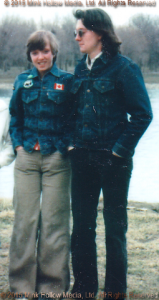
Me with my brother shortly before starting university.

Me with my brother shortly before starting university.

I was quite pretty in those days and rarely had any trouble getting guys to ask me out. In fact, it was rare for me to become friends with a guy who didn’t ask me out.

That also included people I worked with and people I worked for. When I got my first job out of high school working at the Calgary Humane Society, it included the “Special Constable” in charge of complaints who used to like coming in on Sundays when I was working alone. He liked to sneak up behind me, wrap his arms around me and tell me he’d always wanted to be a cross-your-heart bra. He was a big guy, and I was only 16 (yes, I graduate high school when I was 16), so I would just smile and try to squirm away. It also included the owner of the gas station / sporting goods store where I worked after that who fired me for having a ‘bad attitude’. Apparently, refusing to sleep with your short, fat, old boss constitutes a bad attitude. It also included a long list of co-workers – married and not – who would occasionally ask me out or just corner me in the back room of whatever place I was working. I knew it was wrong, but I also knew it was futile to say anything about it. (I’m so glad things are changing in that regard.)

Back to my student days. Given what I was used to out in the “real” world, the kinds of harassment I faced once I was a student was mild by comparison. At least none of the TA’s ever tried to corner me anywhere, and many of them actually treated me with a fair amount of respect, as did most of the faculty. Of course, there was that one professor who called me into his office one time and closed the door. I’d had him for a class the previous semester, so I did kind of know him. The reason he closed the door, he said, was that he wanted to offer me a job, and he didn’t want anyone else to overhear. This professor told me he traveled a lot and gave many talks. He was looking for an assistant. He was actually kind of polite about the whole thing, but I figured out pretty fast that what he was really looking for was an “Assistant” – you know, someone to help him with lots of OTHER things too.
I said no thanks.
Fortunately, by that time, I was already pretty comfortable talking to my department head (he was one of my mentors), and I asked him about this “deal”. He seemed quite well aware of this professor’s antics. He’d never been called on it, and he wasn’t called on it this time either. We just all continued on as if nothing had happened.

CMBIZ078I’d never used a computer before I started university.

I didn’t plan on going into CS. I was going to become an ethologist. Jane Goodall was my role model (still is). I had no plans to continue school beyond my B.Sc.

Around the time I took my first CS course, I was beginning to realize that my chances of doing what I wanted to do with a Biology degree were slim to none. Probably the closest I could come was to be a park ranger, and that didn’t sound fulfilling to me, so I started considering other majors. I took a Psych course and was smitten, but then I took a subsequent course on motivation and lost all of mine. I also took a Geology course. The instructor was fantastic, and I considered becoming a geologist. That summer I worked for an oil company. I spent most of the summer colouring maps and it wasn’t until the last two weeks that I got to try my hand at plotting well-logs. That was fun, but I still couldn’t see myself doing that sort of thing for the rest of my life.

I had actually had me very first experience with a computer (EVER) in a Physics class as part of a lab. We were to run a simulation of a spring. There’s more on that part of the story here.

I became a TA when I was in the 2nd year of my undergraduate degree.

This was very important. This was a monumental thing for me. I’m an introvert and I was always painfully shy in front of crowds – any time I had to give a lab report in biology, I would stutter, my hands would shake, my face got all read and my eyes would start to water. It was awful! And that was when I was allowed to sit at my lab bench and only had to present my report to 5 other people. I’m sure at least some of this came from the fact that I was often picked on and made fun of in school. I was accelerated in grade two (It’s worth noting here that my male principal took six girls and put them in an accelerated program because he thought we were all exceptionally bright. There were no boys in this program.) As a result, I ended up being a good two years younger than my classmates for the rest of my school career – I don’t recommend it. I also got very sick the summer after my dad died and ended up missing a lot of school in high school. It made me stand out, and not in a good way.

Back to university. Here I was in a group of people who thought I could teach a class. I’m sure their confidence in me had a lot to do with my ultimately becoming a CS instructor, and even though the thought of standing at the head of a class terrified me, I tried to remember that even though I didn’t know much, I DID know more than the people in the lab I was teaching, and I would do what I could to help them learn what I knew.

I’ve heard it said that the best way to learn something is to teach it.

My most important course was “Coffee Lounge”.

The CS department where I was taking courses was VERY friendly and welcoming. Faculty, grad students, and undergrads were all part of the same community. This was before the Internet allowed people to work at a distance so everyone had to do their work on campus, in the labs. There was a grad student workroom where grad students AND faculty worked. The door was usually open. There was also a big ‘terminal’ room filled with dumb terminals (a technical term, not an insult) that were connected to mainframes housed in the basement.

We spent a lot of time together. We socialized together. We went to dinner together and had parties together. The department hosted an End of Term party twice a year – paid for by the faculty, and all students were invited – including undergrads. AND, the faculty coffee lounge was always open. I would often go in there, initially with a grad student, but then also by myself. I’d get a coffee (I never paid for it – and was never asked to) and just sit and listen. There were often several faculty members sitting in there having some sort of discussion, and it was more often than not something to do with CS.

I probably logged more hours in that room than I did in any other course I took, and I’m pretty sure I learned more there too. No exams, no assignments, just people passionate and excited about their field having conversations, and sometimes arguments.

I went straight into a master’s after graduating with my BSc.

1981-jnk_wm1981-katrin-81-1I also got married at that time – to one of the guys who had been instrumental in my getting into CS. Because I was already so much a part of the department by the time I got into the masters program, I really didn’t notice much difference.

My years as a student were among the best times of my life, and as an instructor I have always tried to foster the same kind of culture and environment with my students.

More on that in tomorrow’s post.

2 people like this post.

How I Got Into Computer Science (Many Happy Years)

Approximate Reading Time: 3 minutes

Next week I am meeting with a bunch of young women in our department‘s CS and CIS programs, so I’ve been thinking about how I got into computer science, and why I stayed.

Here’s my tale of how I got into CS.

I’ve been at it for a while now. I did my first degrees in the late 1970s and early 1980s.

snap02112

There were regular Faculty/Grad Student sports events.

The CS department where I did my undergrad was still pretty new, and was a place full of incredible enthusiasm. They were very collegial and had a lot fun. This created a real sense of community, and they shared it freely with graduate students and undergrads alike. That was key. They included me like I was one of them right from the very first course that I took. The sense of community was one of the most important factors for me, perhaps because I had so rarely been a part of a community in any school I’d been to before.

snap02114

There were also frequent practical jokes – often played on faculty while they were teaching a class.

Most of the women faculty that I knew in CS were not viable role models*, but it didn’t seem to matter. There were a number of female grad students, and many of them were pretty good role models.

I had viable male role models – and they seemed not to be put off by the fact that I was female – some even LIKED that I was – they made me feel female & desirable AND they made me feel that my intelligence and ability was part of that. None of them seemed to have much time for pretty and dumb, so, after several years in retail (where pretty was really all that mattered), this was a refreshing – and inspiring change.

Some of the faculty were very important role models for me – not only for how to be a computer scientists, but also for how to be an academic. There were also three others who were instrumental in my decision to go into computer science. Understand that I took my first CS course in 1977. I am still in contact with all three. I married one (and I’m still married to him). These were the first guys my age who ever treated me like I was smart. Even weirder – they actually liked the fact that I was smart. The grad student who was my TA in my very first CS class went out of his way to tell me he thought I was good at this. Now, this guy was known as somewhat of a curmudgeon – and one not to suffer fools gladly, so when he told me I had potential, it really meant something.

I had already decided that I liked programming. For me, programming seemed to have a lot to do with sorting and organizing – activities I have always enjoyed. That, and the friendship, support, and confidence of these people were why I got into CS. They are also the reasons I stayed. In the end though I’m pretty sure that if it hadn’t been for the people around me, I would not have made it.

So, forgive me if I forget anyone, but let me end this by thanking the people who are in no small part responsible for my going into CS, and for the many happy years I had while there:

Jim Parker, Neal Reid, Bob Bramwell, David Scroth, Anton Colijn, Mike Williams, Harry Baecker, John Slater, Bill Pulleyblank, and Doug Robinson.

There are plenty of others who were great mentors and friends – many of whom I am still in contact with – but the ones named above are my top 10. I wouldn’t be here without you!


*I have never had much time for strident women who raise themselves up by putting men (or others) down, AND I have little respect for women who feel the need to hide their femaleness (by being frumpy or vulgar). We need to get past the notion that women need to be men in order to make it. Now, truth be told, this is an attitude I have only managed to embrace in more recent years. While I was young, I was willing to compromise on many fronts in order to get the recognition/respect I felt I deserved, so I will not fault young women who do the same. One thing I found was that the more I began to act true to myself in my department, the more people attacked me – especially the women (but more on that in the Why I Got Out post).

Be the first to like.

Gamification 101[21]: Reaching Out to My Students

Approximate Reading Time: < 1 minute

This is the continuing saga of my current iteration of a gamified course (#21).

In a previous post I said I would send out personal emails to all my students, telling them how they are doing and what they need to do to pass this course. Here’s how it went.

I currently have 47 students in my class.

Of those, 1/2 are doing fine. One already has an A.

13 of my students are failing. The mail I sent out told them what their score was and whether or not I though they were doing OK. Those who are failing were told they were seriously behind. I have heard from quite a few of them, promising to submit more quests, but we’ll see who actually does. Most seem quite appreciative that I reached out to them.

This kind of structure is very challenging for some. With no hard deadlines, many students tend to leave the work in this course in favor of other courses that do have deadlines. I do understand that, but I also think it is important for them to learn to get work done when there is no clear deadline.

I’ll let you know in a week or two how many students have ‘pulled up their socks’.


gamificationIf you are interested in following my course journal, watch for the “Gamification 101” heading.

Also, for more information on gamification, check out my website here.

Be the first to like.

Worth Sharing: Peter Higgs: I wouldn’t be productive enough for today’s academic system | Science | The Guardian

Approximate Reading Time: < 1 minute

I know it’s a few years old, but this is really worth a read. It is sobering to consider what we have given up with our current capitalistic, competitive academic system. Universities are not businesses and shouldn’t be run that way. Academia is not a sport. We put far too much emphasis on winning and trying to get to the top of whatever list we have decided is important.

Peter Higgs, the British physicist who gave his name to the Higgs boson, believes no university would employ him in today’s academic system because he would not be considered “productive” enough.

The emeritus professor at Edinburgh University, who says he has never sent an email, browsed the internet or even made a mobile phone call, published fewer than 10 papers after his groundbreaking work, which identified the mechanism by which subatomic material acquires mass, was published in 1964.

He doubts a similar breakthrough could be achieved in today’s academic culture, because of the expectations on academics to collaborate and keep churning out papers. He said: “It’s difficult to imagine how I would ever have enough peace and quiet in the present sort of climate to do what I did in 1964.”

Source: Peter Higgs: I wouldn’t be productive enough for today’s academic system | Science | The Guardian

1 person likes this post.

Gamification 101[20]: Bona Fide Criterion-Referenced Assessment

Approximate Reading Time: 4 minutes

The continuing saga of my current iteration of a gamified course.

Hang on to your hats, this one is radical…..

First, some context.

Theory is nothing without practice. I learn new things with each iteration of the course as I teach it. One of the things I’ve been giving a lot of thought to is the notion of criterion-referenced (CRA) or performance-based assessment (PBA). For me criterion-referenced assessment sounds a little broader in scope. Something that is performance based implies that students must actually do something whereas criterion-referenced includes more of those things we would normally categorize as higher-order thinking (i.e. stuff from the 5th and 6th ‘petals’ of Bloom’s Rose below).

Blooms rose
Here’s the smack on the side of your head.

If we really intend to assess people according to described criteria and if we really want to let go of the simpler time-referenced assessment, then we should be willing to accept ALL relevant evidence created by our students, right?

I know some of you are simply thinking, “Well, sure.” but hold on. Think about this. Are you really prepared to accept bona fide evidence, without regard to when, where, or why it was produced? 

I’ve given this a lot of thought over the last few years and my answer is YES. If we say that showing evidence of competence is the most important thing, then so long as we are confident that the work done is that of the student submitting it, then why should it matter when that work was done? Or where? Or even why?

Now let’s look at the ramifications of this as they constitute a sea change in traditional educational assessment.

What if it is work the student did in the past? What if it is work that was produced for another course? Should we accept it?
….. I say yes.

What if the student is repeating a course? Should we accept work they submitted to the course from the last time they took it?
….. I still say yes.

If we decide that the thing that really counts is that the student be able to show evidence that they have mastered the material we have assigned to them, it shouldn’t matter if they mastered it elsewhere. Why are we so often stuck on this notion that students must produce “fresh evidence”? Does mastery expire?

DBSK11Mostly not, but I’m willing to bet that the thought of accepting work produced in the past would make many educators squirm. The idea of accepting work in one course that has also been submitted for assessment in another course is a time-honored taboo in formal education. But why? Think carefully now. Our students are not submitting papers for publication to some learned periodical. Unless they are PhD candidates and as long as the work submitted is genuinely their own, then there really is no requirement that the work they submit be new.

There are exceptions to the idea that we should accept prior work, of course. Anything that includes formal regulations, laws, or other guidelines that are subject to renewal can indeed have expiry dates. Work that incorporates these must be current and so may legitimately be required to be “fresh”. Similarly things like peer review, and work that connects with current events or other activities that must occur in the present (such as discussions) must also be produced at the time they are required. There is a lot of work that does not fall into one of these categories, however.

What are the benefits of accepting prior work?

For the instructor, none, really. It may actually result in marginally more work because we may now have to assess work that is not the ‘cookie-cutter’ solution we are used to marking. To these instructors I have something to say. If you don’t want to do the work of your profession – then go do something else.

EDU5For the student the benefits are potentially great. Additionally, the potential effect on student engagement and motivation is considerable. If they know ahead of time that a particular piece of work could be used in more than one course, then, assuming they actually care about their grades, they could be motivated to work harder on that assignment. They could even end up learning more than they would by doing a more superficial job on two similar assignments. If we are honest about the realities of student life, then we should also recognize that students occasionally have to make choices about which course work they are going to concentrate on and which ones they are going to try and coast on, or even ignore. If they already have evidence that they have mastered something we need them to master, then what’s the benefit of making them do it again? Aren’t we just making them jump additional hoops? Why not let them submit something they’ve already done and let them spend more time on the things that challenge and/or interest them? Isn’t that what we keep saying we care about?

Here’s the other big plus for students. If we decouple their required work from our calendar, then that gives them choices. If they already have evidence of competence in something we are requiring, then they should be able to submit it right away. They could then get that work off their to-do list and go on to spend time on something that they need to spend more time on. Why should they have to wait until we have ‘released’ our assignment that goes with that unit? And, further, why should they have to wait for feedback until we get around to marking that batch? What is our justification for making them wait, aside from our own convenience, that is?

OK, so what about cheating, you ask? Well, that is always a risk, especially when students have very little contact with their instructors, as is the case at so many large institutions. But cheating is always a risk, and let’s be honest here. If you are teaching a first year class, chances are it’s going to be nearly impossible for you to come up with an assignment that hasn’t been done before. There are going to be some students who will cheat no matter WHAT you do. Wouldn’t it be better to free up your time and energy by letting up on largely pointless anti-cheating efforts so you could spend that time actually helping students? My experience over the years has been that the more I trust my students, the more trust-worthy they actually become. Most people will live up (or down) to meet your expectations, so why not set them high rather than low?


gamificationIf you are interested in following my course journal, watch for the “Gamification 101” heading.

Also, for more information on gamification, check out my website here.

Be the first to like.

Games You Can’t Win – Online First – Springer

Approximate Reading Time: < 1 minute

Dana Ruggiero, Katrin Becker

ID-100283345-300x2251Abstract

A common notion in games for learning is that the player must win the game. But is it always necessary for the player to win in order to ‘get’ the message that the game is trying to portray? When we think back on our most memorable learning experiences, we find that these lessons are often things we learned through failure rather than success. There is a class of games where ‘winning’ doesn’t look the way we typically expect it to look. Some games do not allow their players to win, and their underlying message is more akin to that found in a cautionary tale. We refer to these games as games you can’t win, and they form a distinctly different approach to game design. Games such as Sweatshop (Littleloud, 2011), Darfur is Dying (MTVu, 2006), and September 12th (Newsgaming, 2005) are games you cannot conceivably win, and they are designed that way deliberately. This paper presents a critique on serious games that are unwinnable by design. We examine the concepts of games and learning, the design of unwinnable games, design strategies for unhappy and/or unwinnable learning games, and ways to measure the success of games you can’t win. We also briefly consider potential issues and future directions, and we conclude that the messages delivered via games you can’t win are more powerful than those of games in which you can win.KeywordsUnwinnable Unhappy endstate Educational games Game design

Source: Games You Can’t Win – Online First – Springer

Be the first to like.

Raking Leaves

Approximate Reading Time: < 1 minute

The last few weeks I’ve been watching the groundskeepers at my university clearing leaves with big gas leaf-blowers. It is loud and stinky and they don’t seem to be very efficient. It seems to take several minutes to clear about 20 square feet, and even then there are still quite a lot of leaves left behind. It also isn’t very ‘green’. I wondered what things like this cost.

I thought of the giant fan rakes I see at the hardware store and figure raking with one of these is probably not much harder physically than hauling that big blower around. It would likely cost less. It would certainly be a lot quieter AND it doesn’t emit greenhouse gases. It might even do a better job.


Then I saw this on FaceBook:

 snap02104


WP_20151103_001.mp4Mr. Inventor !!!

This is just the front yard Brian Shreves

Posted by April Medlen on Tuesday, November 3, 2015


I’m pretty sure that with a couple of attachments, maybe even a lighter weight plastic scoop this could be turned into something that works WAY better than those noisy, smelly, gas-guzzling leaf-blowers.

Be the first to like.

Call for Participation: CAUCE-CNIE Waterloo 2016 | Target: Education 3.0 – Possibilities at the Nexus of Pedagogy, Technology, and Access

Approximate Reading Time: < 1 minute

Join colleagues from Canada and around the world for the annual CAUCE-CNIE conference as we explore the shifting directions for the future of education. Waterloo, in the heart of Canada’s Technology Triangle, will be the place to be in 2016 to discuss how societal change, new organizational approaches, technology and innovation are impacting the field of education.

Details Here

Source: CAUCE-CNIE Waterloo 2016 | Target: Education 3.0 – Possibilities at the Nexus of Pedagogy, Technology, and Access

Be the first to like.