Approximate Reading Time: 6 minutes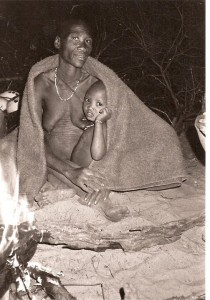
The photo was taken by one of the members of my thesis committee, Dr. Becky Sigmon, who visited me in the field. She took pictures for me while she was there, since my own camera was stolen shortly after I arrived in Botswana.
Are children keen to learn even when they have no schools? How can we teach empathy and self-control? This guest post looks at hunter-gatherer societies and gives us a glimpse into an approach to education and interaction that is different from what we are often led to believe.
Hunter-gatherers do not represent life in our Evolutionary Environment of Adaptation
By Helga Vierich
Originally posted on Facebook, August 2, 2015 at 8:32am
I have a bone to pick with Gray. Not just with him, but with anyone who persists in assuming that the life of hunting and gathering is the “evolutionary environment of adaptation” for humans, and that therefore, the human mind is best suited to such an economy. But this is a fallacy. I have lived with hunter-gatherers, as well as with horticulturalists and pastoralists.. I find no evidence that humans in any of these societies have cognitive specialization to live in their particular economies. I reject the idea that humans have essentially “stone-aged” brains mismatched to life in any other kind of economy, let alone to life in “modern’ cultures.
Humans are engaged in bio-cultural evolution, not limited but liberated by our past. We need not be foragers, or African, to be human; that much is obvious.
What is not immediately obvious, and then glaringly so, is that all of us are as suited to foraging as we are to any OTHER economy, and to Africa as to any other continental ecosystem.
What we are not suited for: injustice, bullying, solitary confinement, or enforced inactivity. (We are also not suited for exposure to constant high levels of malnutrition, fear, stress, or violence, but that is because we are animals, not because we are human.)
Hunting and gathering are economic activities, which are learned aspects of human behaviour. Human behavioural evolution no more equipped us to survive best in “African savanna” than it hampered us in adapting to glaciated Eurasia, nor did it better equip us to get our food by “foraging” rather then by “gardening” or “shopping”.
Our minds are not limited to one kind of economic activity; even foragers can not just understand, but eagerly, actively, and opportunistically exploit all sorts of alternative ways of making a living. It is the consequences that the human mind may not always foresee, a fact as evident in the case of hunter-gatherers first encountering a reciprocal exchange economy as it is in modern market economists who struggle with the concept that there is really no such thing as an “externality” or that economic growth cannot continue indefinitely on a finite planet.
Sure, we evolved within foraging cultures; but that is not the primary fact about human evolution, or about culture, or even about foraging.
Our human nature does not have to change to accommodate living in complex stratified societies.
It is CULTURE, not mobile foraging, that is the essential system to which the human mind and behavioural plasticity adapts.
Adaptation to life as a cultural creature, over the course of several million years, has strengthened the “sapient” side of human nature. We, like many other animals, are capable of mental time travel, we have mental maps, and we can solve puzzles. We have ramped up that ability to analyze – to do what Daniel Kahneman calls “slow thinking” – the energy-expensive kind of cogitating – the “rational” mind. Enhancement of these cognitive abilities catapulted the human system of learned behaviour into a class by itself.
This kind of thinking is what children are taught within hunter-gatherer societies as they play, as they listen to adults telling stories, as they learn to make bows and arrows and to help with cooking over an open fire, as they learn to dance and sing by participating in rituals. But in this, hunter-gatherer children are no different from children in most other economies. Conversations and stories, and watching adults interact, teaches children the value of impulse control, of thinking and talking things over, of achieving consensus, and of forgiveness after disputes.
So… sure we all are capable of selfishness as well as generosity, of meanness and spite as well as cooperation and compassion. Playful cooperation, inclusivity, and curiosity engage the individual within a viable and replicable behavioural and cognitive niche: Serious competition, exclusivity, and disinterest essentially disengage the individual from full participation. Our human nature, transmuted by our long specialization for a predominantly cultural adaptation, is acutely primed for social engagement, for contact, for language and for paradignamic thinking.
So this is my second quibble with both Gray and much of the present literature on children’s education. Certainly, it is an improvement to allow children more time and freedom to play and to add context to what they are learning. But why not go further and talk about WHAT it is that children are really learning? I have never been in any society where children did not want to learn to do things. Even in the middle of the Kalahari, children flocked to look at National Geographic pictures, to see through the microscope and the telescope. By popular demand, I had to open a small bush school, because a delegation of children came to me and wanted to learn to read and write. These were hunter-gatherer children, who freely chose to sit for hours practicing letters on 12 inch slates. I had to engage a school teacher to teach them in SeTswana, but their thirst for literacy, numeracy, – as well as history, music, other languages, geography, or biology – was astonishing.
But I feel that what Gray was really addressing goes much deeper than the way subjects were taught or the amount of repetitive and de-contextual memorization involved. My impression was that Gray was more concerned with individual freedom than with collective responsibility. It might surprise him to know that the hunter-gatherer children I knew were never left unsupervised, and were rarely taken on gathering or hunting expeditions, exceptions being the few occasions where it was a short exuberant trip to a grove where thousands of grubs were harvested over the course of an hour to whoops and amid much laughter. Most children and younger teenagers played at learning adult skills like making tools, working on skins, and tending fires, but the bulk of their time was taken up with games of hide and seek, tag, clapping and singing, or pestering their babysitter for another story.
All this time, they were learning critical interactive behaviour. Hitting, bullying, fighting, and other coercive or manipulative behaviour was met with mocking laughter as it indicated someone had been teased into loss of self-control. By the time they were ten, most of these children were like zen masters in terms of impulse control. Generosity and sharing of food was translated into helpfulness and cooperative turn-taking in all the games and other undertakings. Jokes and laughter permeated all activities.
As to egalitarian principles, and how democratic the families of hunter-gatherers are, Gray does have a point.
It was a specific incident that brought this home to me. I was interviewing some older men about hunting, while a group of boys practiced with shooting arrows at the other end of the camp. One man, who had a cough, called his son and asked him to bring some water. All the boys stopped playing and stared. The boy called to him father “Is something wrong with you?” and pointed to the cache of stoppered ostrich eggs not fifteen feet away from where we were sitting. The other men all began to tease the father, saying that he had forgot himself and was acting high-handed, expecting to be served like a chief. There was general laughter, and the boys went back to playing, while one of the laughing hunters slipped over to the cache, came back on his knees and bowed and scrapped to his friend, handing over the water-filled egg, all the while the other four men were shrieking with mirth over the faux-pas.
I asked about whether it was wrong to ask for help and they all hastily said no, that was not it.. it was assuming the authority to command another person that was wrong. Wow. And yet that same boy, months later when his father was hospitalized (the cough was serious after all) spent weeks sleeping in the hospital corridor and cooking all the meals for his father. You can teach an egalitarian ethic without losing mutual loyalty and responsibility. All children desire to conform to the best values and ideals they are shown. The danger is not in forced conformity, it is in the devaluing of what we teach them to conform to.
Every society that has so far resisted disintegration, every successful and thriving culture on the planet, rewards cooperation and loyalty, justice and fairness, self-discipline and diligence, self-sacrifice and honour.
All successful societies teach children to value these qualities in themselves and in others. No culture long survives the loss of cooperation, love, and compassion; so we should beware of teaching children that some humans deserve more respect and opportunity than others. Why do many industrial cultures, teach children to value competitive activities over cooperative ones? Why do games of one-upmanship seem to dominate children’s free play ? Why is there an epidemic of bullying among school children? Have we forgotten that, in a culture where there is no honour in kindness, death is often kinder than life?
We have a right to be wary about a systems teaching our children that life is about winner-take-all, when we might be equally concerned about that kid who happens to fail. Why are we creating human beings who would die than live one more day?
How, so soon after the enlightenment, have so many people forgotten the stench of politically reinforced injustice that emerges in a severely unequal world? In such an economy, even the wealthy become caricatures, dehumanized, and the poor often would rather die, in the Mediterranean or some refugee camp, than remain mired in a system that gives their children no future.
No matter what education system we impose on our children, shouldn’t respect the essential realities of human nature? Shouldn’t it teach them that they have the right, and the courage, to confront selfishness, coercive aggression, meanness, bullying, injustice, and hubris, where-ever they find it – both within themselves and when they see it in others?
We, as a species, might do worse than find some common ground in these essentials.
Free To Learn: Does The Hunter-Gatherer Style Of Education Work?
EVOLUTION-INSTITUTE.ORG https://evolution-institute.org/article/free-to-learn-hunter-gatherer-style-education/?source=tvol
 2 people like this post.

 What’s the point of hiring competent, creative people if you then don’t let them do what they’re good at?


 If you are interested in serious games, this newsletter is one you should get.
  I just recently submitted the final draft of my
  I think it is essential. I worry about what we lose when kids don’t have free time.
 Hmmmm.
 How many of those people we recognize as extraordinary talents in anything learned they had those talents through school or some thing their parents made them do? A few, to be sure, but certainly not all and maybe not even most.