Teaching Programming Skills

Approximate Reading Time: 4 minutes

I came across this article recently: Tynker Launches Revolutionary New Platform for Teaching Programming Skills to Young Learners Mountain View, CA (PRWEB) April 11, 2013

You know……
I’m starting to think Syntax really IS important.

I recently finished teaching a 1st year programming class in Java. The last time I taught 1st year programming (I mean, really*) was in 2006.

Kids have changed.

* I taught a programming in Alice course in 2008 & 2009, but that’s different.
Read on to find out why.

Now, the kids in this class were of typical intelligence and potential. It was a relatively small class so I got a chance to get to know them (at least, the ones who showed up to class on a regular basis)

As i had done throughout the term, I gave them a ‘free’ work period for their lab on their last assignment. It was a great turnout – almost everyone was there (which is quite impressive because the lab starts at 8am). At one point I looked around the room and it struck me – this did not look like a bunch of people working on a programming problem. I asked them how many were having trouble, and almost everyone put up their hands. For the most part, they were just sitting there – no paper, no notes, just staring at the screen probably wondering why they didn’t know what to do.

I felt like I had failed them, but at the same time I realized there was a limit to what I could do in a single course – and trust me, I had pretty much tried everything I could in the time I had.

So much for digital natives. They may be whizzes at texting (I confess to some envy here as I am not) and they may spend the majority of their waking hours connected, but using is not the same as knowing.

SO much of the tech world is apps written in ways that people don’t need to learn anything – you don’t need to learn anything about the application, or indeed, even the task that the application is design to facilitate.

In many ways this is good – computers are supposed to make our lives easier, ….
BUT (see also Are we teaching our kids to NOT learn?)…..

BUT…..  this  does NOT help anyone learn logic, and logic is ESSENTIAL to programming. AND, learning the picky details of programming language syntax is a integral part of programming literacy.

024Also, it turns out, fluency in logic is essential to problem solving in the general sense (an ability which has serious implications to our continued societal evolution & development).

  • Problem solving requires attention to detail.
  • You need to notice things.
  • You need to be willing to try things – test stuff, you know, let’s see if this idea works.
  • You need to be able to decompose a problem into smaller, more manageable parts.
  • You need to be able to recognize and characterize SYSTEMS.
  • You need to be able to look at something from various levels of abstraction – sometimes simultaneously.

So, here’s a BIG problem:

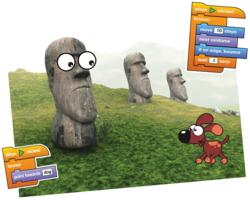
When learning programming using drag and drop tiles (Alice, Scratch, Tynker http://venturebeat.com/2013/04/12/why-your-8-year-old-should-be-coding/, …) they DO NOT learn syntax because we’ve decided it’s not important.And for getting young kids excited about programming, I agree that it’s a great approach. But…..

Stop.
Think about this for a bit.

When you have a visually pleasing graphical interface that hides the structure of the programs you are creating, what people end up doing is just blindly trying stuff. Drag a tile in – see if it does what I need. No? OK try a different one. There’s no analysis – no thought, just play.


Play is great and all, but it turns out you need the rest too – you really do need the structure. You need to learn how to analyse a problem; how to understand a system.


I never realized until this course just how important my original training in CS was. While I would not advocate going back to programming on cards, I learned some very valuable skills because I could not simply sit down at a computer and start to code. I learned to spend the time to understand the problem; I learned to do hand execution; and to “play compiler”. I had to – I often only got one chance per day to test my program (that’s ONE RUN PER DAY). Our assignments were no less complex than ones typically handed out today – so on a typical 2 week assignment we would get AT MOST 10 chances to compile and test out programs (data centers were often closed on the weekends). When you only get 10 tries you MAKE SURE each one is going to count.

Can you even imagine how today’s students would react if you told them they would only be allowed one single compile/run in a 24-hour period? We had 2-hour labs way back then too. What did we DO for 2 hours if we couldn’t repeatedly change a line and compile to see if it worked?

Here’s what we did:

  • We learned how the compiler worked so we could parse our own programs and find bugs before the compiler did.
  • We did hand execution of our programs to verify that our logic was sound.
  • We learned how to do what the program said rather than what we meant during hand execution.
  • We learned to proofread.

We need to help students learn these skills. This is REALLY important.

Be the first to like.

How to write consistently boring scientific literature – Sand-Jensen – 2007 – Oikos – Wiley Online Library

Approximate Reading Time: < 1 minute

How to write consistently boring scientific literature

Sand-Jensen – 2007 – Oikos – Wiley Online Library

2010-05-19_11-33-57This is really quite wonderful. Thank you Margy MacMillan for sending it my way!

Although scientists typically insist that their research is very exciting and adventurous when they talk to laymen and prospective students, the allure of this enthusiasm is too often lost in the predictable, stilted structure and language of their scientific publications. I present here, a top-10 list of recommendations for how to write consistently boring scientific publications. I then discuss why we should and how we could make these contributions more accessible and exciting.

Table 1. Top-10 list of recommendations for writing consistently boring publications.

• Avoid focus
• Avoid originality and personality
• Write l o n g contributions
• Remove implications and speculations
• Leave out illustrations
• Omit necessary steps of reasoning
• Use many abbreviations and terms
• Suppress humor and flowery language
• Degrade biology to statistics
• Quote numerous papers for trivial statements

tags: literature online library writing science

1 person likes this post.

Places I’ve Been to June 13

Approximate Reading Time: 5 minutes
  • Predatory Learning | Boston ReviewThat something, if not explicitly religious, is, fundamentally, spiritual and forward-looking—qualities that are in short supply in the many hundreds of American communities like Racine, where teachers, parents, and students are surrounded by decline. That motivation is rooted in a belief that almost all children and young adults can grow and develop. It builds new institutions, or reorganizes existing ones, around those core values. It places a high value on the direct public relationship—the back and forth, the interaction—between teachers and learners. And the dynamic of teaching and learning that occurs in those schools, at their best, is a kind of secular liturgy. We can’t buy this kind of motivation from the market. No tool or program can spark it. And the elites at the top of the current educational heap—who advanced their careers while the educational culture declined—have no clue. What else is new? The next wave of educational change will be imagined, shaped, tested, and carried forward by the same kinds of pragmatic leaders who built scores of new colleges on the prairie and planted a generation of high schools and then a generation of community colleges in every corner of our country. All nations need building—or rebuilding—including ours.tags: learning education moocs elearning predatory
  • Video gamers really do see more: Gamers capture more information faster for visual decision-makingVideo Gamers Really Do See More: Gamers Capture More Information Faster for Visual Decision-Making June 11, 2013 — Hours spent at the video gaming console not only train a player’s hands to work the buttons on the controller, they probably also train the brain to make better and faster use of visual input, according to Duke University researchers.tags: video gamers information visual study
  • 10 Tips For Creating a Blockbuster Biomedical Game – Bridgeable10 Tips For Creating a Blockbuster Biomedical Game biomedical, bridgeable, education, experience design, games, Healthcare By Bonnie Scott Facebook Twitter Games have become the go-to technology for creating engaging and educational experiences. They have popped up in schools, museums, and corporate and conference events. Within all these new contexts, how can biomedical game designers climb the leaderboard to design the best gaming experiences possible? Our client, a major pharmaceutical company, came to us with a daunting challenge: build a video game to teach attendees at an international psychiatry conference about the pathophysiology of schizophrenia. In case the complexity of the topic wasn’t enough, we also had the task of making the experience fun and engaging in an exhibit space filled with other elements competing for attention. Our solution was a series of short, interconnected games that take a new spin on both quiz- and action-style games. After seeing its success at the conference this May, we wanted to share ten tips that can help YOU design a blockbuster biomedical game.tags: biomedical bridgeable education experience design games Healthcare
  • Quest for Oil – The first oil drilling computer game ever – MaerskWelcome to Quest for Oil! In a unique online gaming environment, Maersk takes you on a quest for one of today’s most indispensable resources – oil. You will go on a subsurface journey, exploring the underground and getting to the heart of the world’s vital and challenging business: the oil industry. Knowledge is power You test your wits against an artificially intelligent digital opponent dedicated to making you lose. Your ability to understand the key challenges of the oil industry is crucial: how to read earth layers, how to detect where to find oil reservoirs and how to know when you’re wasting your time. The analytical decisions you make will determine whether you win or lose. How well do you understand the industry? What is the importance of the seismic phase? How were the earth’s different layers formed? Which of these might yield oil? You will learn the answers to all these questions and then use this knowledge to beat the digital opponent who is constantly trying to beat you.tags: quest oil drilling serious game
  • 7 financial terms every serious entrepreneur should know | VentureBeatThere are brilliant technologists and business leaders in today’s tech world, but while startups have their own, great talents, we’re seeing one common weakness: lack of understanding elementary financial concepts. This impacts long term financial strategy as well as ability to negotiate and set up basic cost structures within the company. Blame it on business school drop outs, or general lack of exposure to financial principles for building that great idea. It’s a growing trend and even professionals outside financial institutions working with startups have taken note. Angel Investor and chairman at HDI company, Mark Schwartz told us, “Most companies don’t have people that are finance savvy other than knowing what to put in a term sheet for an initial capital raise.” Startups forgo hiring a controller to manage the books and create financial reports because of “lean principles.” But even if you aren’t a finance major or don’t employ one, it is every chief executive’s responsibility to understand basic finance principles and how they can affect your business’ bottom line.tags: terms entrepreneur know startup
  • The Little-Known Surprise That Improves Learning in Serious GamesErik Van der Spek conducted a study which was published within the British Journal of Educational Technology. Van der Spek and his peers at the University of Utrecht used a model of the game Half Life 2 to develop a training scenario. The most memorable films and books tend to be the ones that involve intricate plot twists and turns. The endings we remember are the most surprising ones, such as Bruce Willis’s character in The Sixth Sense discovering his own shocking identity, or Darth Vadar revealing that he is Luke’s father in The Empire Strikes Back. We like to be wrong footed by the unexpected in cinema and television.tags: surprise learning games stud y DGBL serious
  • 27 Stunning Works Of Art You Won’t Believe Aren’t Photographs27 Stunning Works Of Art You Won’t Believe Aren’t Photographstags: works art photographs
  • U OF O WATCH: The cross-examination of Professor Rancourt continues: Blog articles and student spy report introduced into evidenceU OF O WATCH This site is devoted to transparency at the University of Ottawa, Ottawa, Canada. UofOWatch exposes institutional behaviour that is not consistent with the public good.tags: professor bullying academic mobbibg
  • Outdoor Time and Personality: Organic GardeningOutdoor Time Makes You a Better Person Studies show that even brief exposure to nature seems to make people more caring and community oriented. By Megan Othersen Gorman ||||| Printer-friendly version exercising in nature will do wonders for your personalityA little outdoor time may have positive effects on your personality, even if you’re not aware of it. Research published just this month in the journal Personality and Social Psychology Bulletin found that even the most minimal exposure to nature—even something as simple keeping houseplants around—makes us demonstrably more caring people.tags: nature outside rural life
  • A Neurologist Makes the Case for the Video Game Model as a Learning Tool | EdutopiaThe popularity of video games is not the enemy of education, but rather a model for best teaching strategies. Games insert players at their achievable challenge level and reward player effort and practice with acknowledgement of incremental goal progress, not just final product. The fuel for this process is the pleasure experience related to the release of dopamine. Dopamine Motivation The human brain, much like that of most mammals, has hardwired physiological responses that had survival value at some point in evolutionary progression. The dopamine-reward system is fueled by the brain’s recognition of making a successful prediction, choice, or behavioral response. Dopamine is a neurotransmitter that, when released in higher than usual amounts, goes beyond the synapse and flows to other regions of the brain producing a powerful pleasure response. This is a deep satisfaction, such as quenching a long thirst. After making a prediction, choice, or action, and receiving feedback that it was correct, the reward from the release of dopamine prompts the brain seek future opportunities to repeat the action. For animal survival, this promotes life or species-sustaining choices and behaviors, such as following a new scent that leads to a mate or a meal and remembering that scent the next time it is present.tags: video game model learning tool edutopia

Posted from Diigo. The rest of my favorite links are here.

Be the first to like.

Cloud computing is a trap, warns GNU founder | Technology | guardian.co.uk

Approximate Reading Time: < 1 minute

Cloud computing is a trap, warns GNU founder | Technology | guardian.co.uk.

YES!

This is yet another example of the delusion that comes from being a technophile without also being fully literate in  an increasingly technological society . With no clear understanding of the implications of cloud technology, people happily become reliant on a host of companies with worthy and not-so-worthy motives. I come across more academics and educators who blindly park their personal IP out there with no back-up, and no contingency should something go wrong.

cloud computing was simply a trap aimed at forcing more people to buy into locked, proprietary systems that would cost them more and more over time.

“It’s stupidity. It’s worse than stupidity: it’s a marketing hype campaign,” he told The Guardian.

“Somebody is saying this is inevitable – and whenever you hear somebody saying that, it’s very likely to be a set of businesses campaigning to make it true.”

Unfortunately, there is a real tendency for people in formal education to treat technology as more of a fashion item than tool.

2 people like this post.

Cheating to Learn: How a UCLA professor gamed a game theory midterm | Which Way L.A.?

Approximate Reading Time: < 1 minute

Cheating to Learn: How a UCLA professor gamed a game theory midterm | Which Way L.A.?.

In the end, the students learned what social insects like ants and termites have known for hundreds of millions of years. To win at some games, cooperation is better than competition.  Unity that arises through a diversity of opinion is stronger than any solitary competitor.

Sadly, many, if not most of the exams I’ve seen aren’t nearly interesting or challenging enough for an approach like this to even make sense.

In order for this to work, you need to have some interesting and challenging questions.

You also need to know your subject matter fairly well.

Be the first to like.

Cheating or not? | Granted, and…

Approximate Reading Time: 2 minutes

Cheating or not? | Granted, and….

Cheating or not?

As the school year ends and many of you have student papers due, here’s an ethical challenge related to such assignments, put to the New York Times Ethicist last Sunday:

When I was in college, I’d sometimes write a single paper that would satisfy assignments in more than one course. For instance, I once wrote a paper on how “The Love Song of J. Alfred Prufrock” expressed satire; I submitted it for assignments in both my poetry course as well as my completely separate satire course. I did not disclose this to either professor. When I share this with people, half call the practice cheating, and the other half call it genius. My niece told me it would certainly be grounds for expulsion at her college. In my mind, I was adding a level of intellectual complexity to my studies. Was this an ethical practice, or was I cheating?

Readers, what do you think?

Good Question.

Here’s my answer:

If you create a paper, essay, or project that will work for several assignments simultaneously, I think that’s fine. On the other hand, if you take something you completed previously, and submit it to a subsequent course, you are avoiding the object of the assignment (which *should* be to learn something), and that’s not acceptable.
As has been said above, the first approach could easily require a deeper understanding of the material/learning objectives in BOTH courses, and so should be permissible. It would be good for the student to let both instructors know – but I also know how inflexible many instructors can be, so I don’t actually blame the student for saying nothing.
If a student hands me something that I discover has been submitted for grading before, I would give them 0 or tell them to do a real one and submit that. They need to know this is not acceptable, but there are FAR too many cases of academics submitting what amounts to the same paper to multiple venues, for us to get all high and mighty about this. It’s great opportunity to talk about some of the fine and blurry lines in academic integrity.

Be the first to like.

Do the Best Professors Get the Worst Ratings? | Psychology Today

Approximate Reading Time: 2 minutes

As the study’s authors put it, ‘Appearances Can Be Deceiving: Instructor Fluency Increases Perceptions of Learning Without Increasing Actual Learning.” Or, as Inside Higher Ed put it, when it comes to lectures, Charisma Doesn’t Count, at least not for learning. Perhaps these findings help explain why people love TED talks.

via Do the Best Professors Get the Worst Ratings? | Psychology Today.

This also relates to some of the things I’ve said about pseudoteaching.

It seems there are actually data to support the idea that often, the most popular professors – you know, the ones who continually crow about their teaching awards – are *not* in fact, the best educators*, merely the best politicians.

When you measure performance in the courses the professors taught (i.e., how intro students did in intro), the less experienced and less qualified professors produced the best performance. They also got the highest student evaluation scores. But more experienced and qualified professors’ students did best in follow-on courses (i.e., their intro students did best in advanced classes).

The authors speculate that the more experienced professors tend to “broaden the curriculum and produce students with a deeper understanding of the material.” (p. 430) That is, because they don’t teach directly to the test, they do worse in the short run but better in the long run.

To summarize the findings: because they didn’t teach to the test, the professors who instilled the deepest learning in their students came out looking the worst in terms of student evaluations and initial exam performance. To me, these results were staggering, and I don’t say that lightly.

Bottom line? Student evaluations are of questionable value.

* I have known a few teaching award recipients who actually were very good teachers, but I’ve known more who didn’t actually know that much; they were just good at making their students feel good. I even knew one who used to hand out teaching award applications in his class.

Be the first to like.

30 or so eLearning Tools, and a few lists.

Approximate Reading Time: 7 minutes

From time to time I come across a number of useful resources, and rather than bookmark them (never to be found again), I am putting them in my blog so I can search for them. This is one of those sets.

Disclaimer: I have not checked all of these tools out myself as yet, so can’t give you an assessment.Note that most of the descriptions come from the websites themselves, so they tend to be a little ad-y.
I have commented on the ones I have used.My comments are highlighted in green. While it may not be important for most people anymore, one aspect that is important to me is the ability to access and use the utilities offline. I live in the country and do not always have good bandwidth. Also, I think it’s a really BAD idea to put all your stuff out there in the cloud.

Courseware Presentation Creation / Editing

CourselabCourseLab is a powerful, yet easy-to-use, e-Learning authoring tool that offers a programming-free WYSIWYG environment for creating high-quality interactive e-Learning content that can be published on the Internet, Learning Management Systems (LMS), CD-ROMs and other devices. CourseLab is available as a commercial product (version 2.7) and as freeware (version 2.4).

Easygenerator’s free edition allows you to create great eLearning courses for free. Discover what next generation eLearning means. Register now and start creating great eLearning courses within minutes.

edyncoVisual all-in-one Learning Platform.


The Slidepoint Technology began development in the Atrixware offices in early 2009. It was implemented first as a plug-in app for the popular Atrixware Weblearning LMS, and then went live as a stand-alone service for all in 2011. Slidepoint was designed to provide the ability to create and deliver online presentations that do not require the Adobe Flash player to operate, and therefore work on any desktop or mobile device that supports html, css and javascript. The slidepoint.net site specifically was designed to enable anyone to create and deliver the presentations at no cost.

Udutu™ offers easy to use online learning solutions designed to help small and large organizations build and distribute online training courses.  Our user friendly software and support network will help you to create highly interactive online courses quickly, easily and affordably.

Wink is a Tutorial and Presentation creation software, primarily aimed at creating tutorials on how to use software (like a tutor for MS-Word/Excel etc). Using Wink you can capture screenshots, add explanations boxes, buttons, titles etc and generate a highly effective tutorial for your users.

The Xerte Project provides a suite of award-winning open-source tools for elearning developers and content authors producing interactive learning materials. The tools are in use in institutions and organisations all over the world, with an enthusiastic community of users, and an active team of developers working to bring new features and enhancements to the software.

Zembl has a wide range of features to put you in control of the content you produce. Administer teams easily, collaboratively develop using rich media content, popular question types and dynamic templating while handling bug requests all from within your browser. When it is time to publish your online learning, be confident that our universal export will deliver the content how you want it.

Video / Screen Capture / Creation

animotoCreation of animated picture shows, videos with audio. (Videos for everyday events to life’s most important memories.)


Use our Video Maker to create videos for free.

  • Make a viral video.
  • Create an animated lesson for your class.
  • Make an explainer video for your product, a demo video for your business, or a training video for your staff.

One-click screen capture recording on Windows or Mac computers with no install for FREE!


Snagit gives you all the tools you need to create eye-catching images and videos for easy sharing. Customize Snagit to meet your specific needs or the needs of your entire organization.

KB: Fairly easy to use. Offers little in the way of video editing. If you are using it to record a slideshow, note that it does not give you a way to re-do a slide, although you can freely pause and resume.

Snap! by Lectora® changes the PowerPoint
e-Learning market forever. For only $99, create engaging Flash content in minutes. Absolutely no learning curve and no more breaking the bank. Snap! by Lectora truly reinvents the term ‘rapid’ by providing you with easy-to-use e-Learning software to create stunning courses, presentations, and fun Flash content.

KB: This is my choice for presentation video creation. It also does eLearning. Has most of the features the expensive ones have but costs just under $100.00 It’s a little clunky at times, but it is more editable than Snagit.

wideo

Create your animated videos for free.


Audio Tools

Audacity® is free, open source, cross-platform software for recording and editing sounds.

 KB: Fairly easy to use. Powerful with many features. Can be installed on a thumbdrive to make it portable.

snap00807 Freesound is a collaborative database of Creative Commons Licensed sounds. Browse, download and share sounds.


Visualization Tools

Create and share visual ideas online. vhemes are visual themes. drag and drop a vheme onto your canvas for easy creation of your visual idea!

For visual mapping, outlining, writing and making presentations, use Inspiration® 9, the ultimate thinking and learning tool. Brainstorm ideas, structure your thoughts and visually communicate concepts to strengthen understanding with the Diagram and Map Views. To take notes, organize information, and structure writing for plans, papers and reports, use the integrated Outline View to focus on main and supporting ideas and to clarify thinking in written form. With Inspiration’s Presentation Manager, transform your diagrams, mind maps and outlines into polished presentations that communicate ideas clearly and demonstrate understanding and knowledge.

KB: Has nice features for connecting nodes. Has an automated re-arrangement utility. Allows you to save in many different formats.

pearltreesPearltrees is your visual and collaborative library. It lets you collect, organize and share everything you like. It is a library of your digital life where you can collect web pages, photos and notes about the things you like. Then you can organize them as you please and keep them at your finger tips. For example, if you like movies you could organize a pearltree about “cinema” to make it easy to relocate your favorite finds in your library with just a few clicks. In addition, it’s social: you can discover millions of pearls organized by other people that share your interests. It’s ideal for enriching your library on any topic you care about.

KB: An online spreadsheet editor that will allow you to create html5 spreadsheets, including calculators. You can see an example of a calculator I built HERE (this is the page where it’s linked).


Collaboration / Project Management Tools

KB: To Do List manager. Relatively lean. I find it really handy for day to day tasks. I haven’t tried using it collaboratively. Allows both online and offline use. The online app syncs when you are connected, but you can still use it when you are offline.

Online project management tool. Trello is the fastest, easiest way to organize anything, from your day-to-day work, to a favorite side project, to your greatest life plans.


VyewVyew allows you to meet and share content in real-time or anytime. Upload images, files, documents and videos into a room. Users can access and contribute at anytime.


wiggioWe developed Wiggio out of our own frustrations with working in groups. We were tired of sending eleven emails back and forth to set a meeting time. We were fed up with “that guy” who just never knows where and when to be for meetings. We were tired of multiple mailing lists, contact books, phone-chains and incompatibilities. We wanted everything to be in one place, and we wanted it simple.

KB: Fairly easy to use. Friendly – quite a lot of features.

Citation / Reference Management

EndNote® gives you the tools you need for searching, organizing and sharing your research. It allows you to easily create bibliographies while writing your next paper with features like Cite While You Write®. Maximize your time with features like finding full text for your references and automatically updating records. Whether you’re on your desktop, online, or iPad, EndNote’s syncing capabilities let you access all of your references, attachments, and groups from anywhere.

KB: I started using this one when I began my doctoral work. I love the ‘cite while your write’ feature – it allows you to insert a citation in the text of your word document, and it will automatically add the reference to the end of your document. Also allows you to change the citation style with just a few clicks (to any of hundreds of built-in styles). Extremely customizable. I also like that you can use it online or off. I use it primarily offline.

Zotero is the only research tool that automatically senses content, allowing you to add it to your personal library with a single click. Whether you’re searching for a preprint on arXiv.org, a journal article from JSTOR, a news story from the New York Times, or a book from your university library catalog, Zotero has you covered with support for thousands of sites.

KB: I use Endnote, but a lot of people like this one.

Website / Graphics

kulerA colour wheel for creating colour themes.


Pixie is a utility made especially for webmasters and designers. It is a color picker with few extra goodies. Run it, simply point to a color and it will tell you the hex, RGB, HTML, CMYK and HSV values of that color. You can then use these values to reproduce the selected color in your favorite programs. Pixie will also show the current coordinates of your mouse pointer

KB: Very similar to Pixie. Has a Firefox plugin that you can access from the browser toolbar.


is an online tool that makes it easy for you to create, link together, preview, and share mockups of your website or application. It creates wireframes.

Miscellaneous

Evernote makes it easy to remember things big and small from your everyday life using your computer, phone, tablet and the web.

KB: I’ve tried it – looks promising but doesn’t seem to match my personal style enough to keep me using it.

speedtest.netWelcome to Speedtest.net Are you getting the speed you pay for? Our Promise Index™ and Speedtest.net help keep your ISP honest! You can help too and join over 250 million others like you who want to test or troubleshoot their Internet connection. What’s your Speed?

Other Lists

Be the first to like.