Approximate Reading Time: 12 minutesI thought I’d take a wee break from the Gamification 101 posts to post a paper I wrote describing a gamified ID model. Gamification is still relatively new – far too new for there to be any decent guidelines for how to go about designing instruction this way. I will likely re-vamp this paper at some point and publish it somewhere, but in the meantime, I thought at least a few people might find it useful (If you do, by the way, drop me a line!)
Abstract
In his landmark paper describing what the new post-industrial paradigm of instruction should look like, C.M.Reigeluth outlines 8 core ideas:
- Learning-focused vs. sorting focused.
- Learner-centered vs. teacher-centered instruction.
- Learning by doing vs. teacher presenting.
- Attainment-based vs. time-based progress.
- Customized vs. standardized instruction.
- Criterion-referenced vs. norm-referenced testing.
- Collaborative vs. individual.
- Enjoyable vs. unpleasant. [1]
Most of us would acknowledge that people learn at different rates and have different learning needs, but most of our courses continue to enforce a lock-step progression of topics and assignments that is much better suited to an industrial style of teaching and learning than a 21st century one. Reigeluth’s new paradigm calls for radical transformation and while that may well be justified, radical change to our institutional structures is unlikely to happen, at least not in the near future. What then can we do in the meantime? Gamification is a pedagogy that can be implemented without the need for institutional systemic change. This paper examines Reigluth’s core ideas and proposes a variety of changes that can easily be implemented in the classroom to address them. It then presents an instructional design model that can be used to guide the design and development of a gamified course.
Introduction
Formal education needs to change. In a spell-binding rant at the opening plenary of the 2004 Education Arcade, Brenda Laurel made the claim that North American public education is primarily about the following:
- Socialization: read- entrainment to authority.
- Babysitting- so parents can work.
- Training future workers- to create an efficient under class of workers.
- Teaching good test-taking behavior.
Further, she asserted that formal education was hierarchical, authoritarian, and did not encourage personal agency [2]. While we may not feel quite as strongly as this, there is an element of truth in Laurel’s rant, and even though these claims are more than a decade old, in many ways, little has changed. As one of the best-known current educational theorists, Charles Reigeluth has in recent years focused his attention on the kinds of systemic changes needed to implement a post-industrial education system that can meet modern educational needs [1]. It turns out that a gamified model of designing instruction can address Reigeluth’s requirements. Whereas the traditional industrial-age approach to formal education is largely focused on factual knowledge, competition, and compliance, the post-industrial model should focus on problem-solving, cooperation, and personal ownership of learning.
Gamification can be broadly defined as the application of game features and game mechanics in a non-game context, but gamification does not typically include using actual games. Like most new approaches, it has both champions and detractors. Vocal critics such as Ian Bogost complain that gamification often takes “the least essential aspects of games and presents them as the most essential.” He describes it as little more than ‘pointsification’ designed to motivate participants with superficial rewards and refers to it as exploitationware [3]. This simplified application of the concepts is typically embodied in what others refer to as ‘PBL’, which stands for “Points, Badges, and Leaderboards”. Charles, Charles, McNeill, Bustard and Black [4] simplify the term even further to awarding “points to students for the successful completion of tasks throughout the course of study”, but this can easily degrade into nothing more than a translation of letter grades to points. Gamification need not be trivialized in this way. In fact, the concept of gamification has far more potential than that promised by slick marketing or superficial applications. When one looks more closely, one finds that many of the ideas described as part of meaningful gamification are not new at all and the author suggests that this new term can be quite useful. Gamification can be used to describe the collection of strategies that together can create the kind of post-industrial paradigm of education that Reigeluth says is needed.
Gamification and Reigeluth’s Paradigm
While many aspects of gamification are *not* new, some are, and when taken together they create a pedagogy that could qualify as one of Reigeluth’s post-industrial paradigms. Gamification, done right, addresses all eight of his core ideas.
Learning vs Sorting
It can be a real challenge to create an environment that focuses on helping students learn rather than sorting them into those who can and those who can’t, especially in university classes with large enrollments. The idea of designing instruction and assessment to foster learning rather than simply sorting students is really the core idea that underlies the other seven. We have been sorting students in formal education for a very long time, and it is known that a student’s grades affect their likelihood of either staying in or transferring out of a particular program [5], and a student’s sense of belonging can profoundly affect their persistence and retention rates [6]. Giving them choices and providing opportunities for students to take control of their own learning gives them ownership of their grades and a sense of being an active participant rather than just the recipient.
Learner Centered vs Teacher Centered
McCombs and Whisler [7] define learner centered as: “The perspective that couples a focus on individual learners (their heredity, experiences, perspectives, backgrounds, talents, interests, capacities, and needs) with a focus on learning (the best available knowledge about learning and how it occurs and about teaching practices that are most effective in promoting the highest levels of motivation, learning, and achievement for all learners)” (p. 9). Students who are permitted the opportunity to choose and control their learning report higher motivation, greater commitment, deeper involvement, and more strategic thinking [8, 9]. There are a number of ways of providing choice, such as being able to choose which problems to complete, variations on specific problems, allowing for resubmission, proposing work not assigned, and the relaxation of strict deadlines [10]. Games rarely require the player to complete all challenges perfectly in order to win. A key aspect of a pedagogically gamified approach to providing choice would to provide students with a greater number and variety of tasks to complete than are needed for a perfect score. In the most recent gamified course taught be the author a perfect score was deemed to be 1000 points (for ease of translation to the university’s standard grading scheme), but the total number of points possible if students were to complete everything perfectly was over 1500 [11].
Doing vs Listening and Watching
As much as possible, students should spend their time learning by doing rather than listening to lectures, reading textbooks, and watching others. Sometimes teaching via lecture, assigned reading, or video is appropriate, but it is far too easy to simply choose a textbook and then follow that chapter by chapter. We need to focus on what students can do – beyond writing exams – to demonstrate their mastery of the subject matter. Assignments (quests) should focus on what students can do to demonstrate mastery of the material rather than simply being able to repeat what they’ve been told.
Attainment-Based vs Time Based
The idea behind attainment-based instruction is that students move on to a new topic or competency when a standard of achievement has been attained, rather than when a certain amount of time has passed. Along with that goes the notion that students should be allowed to move on as soon as they have mastered it and that students can remain with a topic until they have mastered it. In this way students are not made to waste their time. This form of progression is the norm in games. In a typical game players start with a score of zero. Contrast that with a typical course where, whether it is stated explicitly or not, most students go into a course imagining they have an ‘A’, and every time they earn less than a perfect score on something, they see it as having done something wrong. In a gamified course, all students start off with a score of zero, and everything they do adds to their score. If they blow an assignment they simply earn fewer points and must re-do it, or do something else to earn the points they need. There is no one thing they can do that will prevent them from earning an ‘A’. this has a profound impact on the risk associated with any individual item and often results in students trying things they might otherwise not, which can in turn result in students actually learning more.
Customized vs Standardized
This idea should include customized content as well as customized methods. It is often not practical to do this individually in a large class – although it is possible in smaller classes. It is possible however to set up a collection of content, methods and work that allows students to choose from a variety of tasks. It is also possible to support a variety of paths through the course content. When a game is designed it usually gets laid out in a map according to the places the player can access or the regions on the game world. Each “node” in the map is a place where the player can do something. All eventually lead to the final challenge of the game. Sometimes you can go directly to the end game but players will rarely have the skills and assets they need in order to meet the final challenge. We can take this same approach to the design of allowable paths through a course. Although most of us learned our disciplines through lectures and textbooks that were organized linearly (see Figure 1), there is nothing inherently natural about this approach. If we consider the actual dependencies of various topics and concepts, we can use that to create a flexible learning path (Figure 2). Clearly, some topics must be addressed in a specific order, but others may be order-independent, and some will be required while others can be optional. This has the added benefit of making relationships between the various topics explicit.

| Figure 1 – Typical Course Structure |

| Figure 2 Gamified Course Structure |
Criterion Referenced vs Norm Referenced
Norm-referenced assessment is still the norm (pardon the pun) in many, if not most university classes. We have come to assume that letter grades should be allotted to students based on a statistically normal distribution, but what if everyone in the class manages to meet the stated course objectives? Criterion referenced assessment involves an independently determined set of standards for achievement. So long as the student meets the criterion, they should earn the grade promised. In a typical course when a student earns 65% (which is a pass in most institutions) it is meant to imply that they have mastered approximately 2/3 of the course content, but is this really true? In a course where 60% or more of the final grade comes from exams their grade is in fact only a measure of the percentage of the content of the exams that they have mastered. Of necessity the exams include only a fraction of the course material that was taught. In a gamified design students are assessed on the work they do over the term, and although final exams are still possible, they should could towards the final ‘score’ in the same way as all other work. If students manage to earn 1000 points throughout the term, then why should they be made to write a final exam? Haven’t they already demonstrated their mastery of the material? We of course still want to retain rigour & accountability but that can be done by setting appropriate standards for the work that is submitted.
Collaborative vs Individual
For the rest of their professional careers, most graduates will be working in teams rather than individually. We need not only to provide more opportunities to allow them to work in teams, but we must help them learn how to work in teams and find better ways to assess their team work. With tools such as Google Drive that supports collaborative work and that has the ability to track who does what, it is easier than ever before to allow encourage group work while still monitoring individual contributions.
Enjoyable vs Unpleasant
Students deserve transparency in the way they are to be assessed. In fact, there are two key questions to which every student should be able to expect an answer when asked to perform some learning activity: 1) “Why am I doing this?”, and 2) “What is this good for?” That is not to say that each requirement must be immediately applicable in a practical sense, but it does mean that instructors should be able to help students “connect the dots” from what they are learning now to something that will be of practical use eventually.
If we put all of these ideas together, we end up with a model that is very like the way many games are set up, and, just like a game, this requires that the bulk of the course be designed before the course begins. The following is an instructional design model that outlines how this can be done.
A Gamified ID Model
Many course designs in science faculties have a very similar course structure: there are 5-6 assignments, due roughly every two weeks, one or two midterm exams and a final. There may or may not be a major paper or project and there may be a small variety of ‘small-value’ items such as quizzes and short exercises. A gamified course design can still include all of those things, but the way in which the grades contribute to the final score is now cumulative rather than having each score be distinct. This requires that there be more opportunities to earn marks than are needed for a perfect score. Figure 3 outlines an instructional design model that supports a gamified course design.

| Figure 3 Gamified ID Model |
Determine Needs, Learner Characteristics: In many university courses, this phase of the design will likely already have been decided, but it is often beneficial to state what you know, which can then be revisited in subsequent designs to make sure it is till appropriate.
Determine Instructional Objectives: This part may similarly be mandated and you may have no choice, but as with the previous phase, it can be very helpful to write it down in black and white.
Map out Learning Path: By mapping out the topics and concepts as a set of interrelated nodes rather than a linear progression of topics, we can create multiple paths through the course material allowing students to plan their learning. Mapping out our courses in this way has several effects:
- It releases us and our students from the lock-step progression through content. This was never a reality anyways – people learn at different rates so people will always be at different places.
- The relationships between the nodes are now determined by content rather than time.
Each node in our map will ultimately have various learning tasks (quests) and resources associated with it.
Mise-en-scène & Narrative: Plan Time, Space, Resources: Mise-en-scène means ‘setting the stage’ and in our context refers to those aspects of the course design that include such things as the vocabulary we use and whether or not we will create a narrative. Many gamified courses include an overarching narrative for the course [12], but this is not necessary in a gamified design and in some cases can be detrimental. English courses provide a natural environment for the use of a narrative, but something like a chemistry or education course may not. If a narrative appears contrived, it can result in students feeling disengaged from the course. However, if a narrative is to be used then we will need to develop that as well.
The next four ‘phases’ should be completed simultaneously as they are all interrelated.
Develop Instruction & Select Instructional Strategies: Instructional strategies are the approaches you plan to take to deliver the content and to engage students with the material so they are able to meet the course objectives. This also includes developing or gathering the various resources that students will be able to access, such as PowerPoints, websites, examples, and so on.
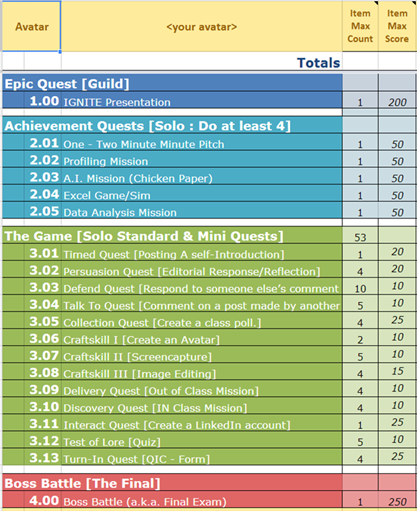
| Figure 4 – Quests for a 1st Year Introduction to Computers course. |
Develop Quests & Reward Structure: An important aspect to recognizing competence is acknowledging that if you really want to recognize and encourage learning, then you must give your students sufficient opportunity to try.
This includes allowing them to re-submit work if it was not done well enough. In almost every other learning endeavor, we keep trying until we get good enough to succeed. When learning to walk we fall down and get up again, many, MANY times. Why then do we so rarely give our students opportunities to fix their work and have it re-assessed? The author has been allowing re-submission of student work for nearly 20 years – in classes that range from 6 – 250 students [10]. A very small percentage (< 10%) of students actually re-do something, so it really doesn’t add much to the instructor’s workload. It does however, require that assignments are marked and results returned quickly. Here again, there are ways to set up submissions so that accessing them for assessment is fairly straight-forward.
Figure 4 shows a summary of the quests and their scores for a course the author designed and delivered in 2013 and 2014. Note that there are a wide variety of quests (=assignments). The “Item Max Count” indicates how many times a particular task can be repeated for marks. Each repetition must be distinct, and students must attempt each kind of task at least once. This ensures that all students end up with a variety of experiences that cover the course content without skipping any parts.
Conclusion
This kind of course design requires significant up-front preparation, but once complete it does not take more of the instructor’s time than a more typical course. The author has taught courses using this design a number of times, and while the marking load is constant throughout the term, with appropriate technology (such as Google Apps) for scoring and communicating with students, the actual load is not appreciably heavier than in a traditional class.
From the student side of things, they also have some adjustments to make. This design requires them to take ownership of their own learning. They will need to work to motivate themselves. They will also need to learn to manage their time and sometimes strategize to choose the tasks that will benefit them the most. Many students report that they really like the freedom that this design affords them. They can work ahead when they have time and are free to focus on other courses or personal matters when necessary. There are a number of students who have difficulty with the freedom this design affords and who need more structure, but even most of those have reported that they like the design.
References
[1] C. M. Reigeluth, “Instructional Theory and Technology for the New Paradigm of Education,” Revista de Educación a Distancia, vol. 11, Sept. 30 2012 2012.
[2] J. P. Gee, W. Spector, B. Laurel, W. J. Au, and H. Jenkins, “Opening Plenary: Are Games Educational?,” in Games in Education Conference, ed. Los Angeles, CA: MIT, 2004.
[3] I. Bogost. (2012, Oct 2, 2012). Persuasive Games: Exploitationware. Gamasutra. Available: http://www.gamasutra.com/view/feature/6366/persuasive_games_exploitationware.php
[4] D. Charles, T. Charles, M. McNeill, D. Bustard, and M. Black, “Game-based feedback for educational multi-user virtual environments,” British Journal of Educational Technology, vol. 42, pp. 638-654, 2011.
[5] P. Arcidiacono, “Ability sorting and the returns to college major,” Journal of Econometrics, vol. 121, pp. 343-375, 7// 2004.
[6] E. Kim and J. P. Irwin, “College Students’ Sense of Belonging: A Key to Educational Success for All Students by Terrell L. Strayhorn (review),” The Review of Higher Education, vol. 37, pp. 119-122, 2013.
[7] B. L. McCombs and J. S. Whisler, The learner-centered classroom and school : strategies for increasing student motivation and achievement, 1st ed. San Francisco: Jossey-Bass, 1997.
[8] R. W. Adler, M. J. Milne, and R. Stablein, “Situated motivation: An empirical test in an accounting course,” Canadian Journal of Administrative Sciences, 2001.
[9] K. Peer and M. Martin, “The leaner-centered syllabus: From theory to practice in allied health education,” The Internet Journal of Allied Health Sciences and Practice, vol. 3, April 2005.
[10] K. Becker, “How much choice is too much?,” SIGCSE Bull., vol. 38, pp. 78-82, 2006.
[11] K. Becker, “Gamification: A Different Paradigm of Pedagogy,” 2014.
[12] L. Sheldon, The multiplayer classroom : designing coursework as a game. Australia ; Boston, Mass.: Course Technology/Cengage Learning, 2012.
 3 people like this post.


 Google Drive – containing three sub-folders:


 If you are interested in following my course journal, watch for the “Gamification 101” heading.
 A list by James Hague:


 As long as I can remember, September has been the start of the school year. It’s always exciting and filled with new hope and opportunities. Fresh paper; new pencils and all that.