Approximate Reading Time: 10 minutes
This is the response to Ian Schreiber’s comments from the original draft post. (THANK YOU for the help!)
Points
Point values for quests is unclear – everything in the 1000s doesn’t seem arbitrary, sounds like it’s a system like any other, just might be an unbalanced system if value is not commensurate with effort/skill.
Fair enough. A consistent system is important, and I agree that whatever system is used should bear some connection to the effort/skill associated with each task. That said, I do think that using scores that are all in the 1,000’s makes the scoring seem somewhat artificial (and more than a little inflated).
Consider this example of points mapped onto letter grades. Now, the mapping onto letter grades is important in any situation where the student’s the course will ultimately be recorded as a letter grade, but it doesn’t have to confound.
| 125,000 |
A |
| 110,000 |
A- |
| 100,000 |
B+ |
| 90,000 |
B |
| 80,000 |
B- |
| 70,000 |
C+ |
| 65,000 |
C |
| 60,000 |
C- |
| 55,000 |
D+ |
Consider further, that the smallest individual item for which you can earn points has a point value of 1,000 points. If I might be so bold as to ask, What’s the point?
I would like to advocate for truly meaningful points in learning applications. Sure, it is common for entertainment games to measure things in 100’s or even 1,000’s of points, and I suppose it’s fun to see your score go up into the millions after a few minutes of play. BUT, is that really something that is useful in a learning context? I suspect this might be fun for hard-core gamers, or at least some of them. I’ve had more than a few self-described hardcore gamers complain that they didn’t want their courses to mimic the games they play for fun.
When designing educational experiences, we need to be really careful that we don’t merely exchange one group of disengaged learners for a different group of disengaged learners, and this sort of scoring system can certainly prompt some students to take your course less seriously (BTW taking a course seriously and having fun in that same course are not mutually exclusive).
When trying to decide on a point scale for your course, consider these questions.
- What is the smallest actual point value you plan to give out?
Are you ever going to make a distinction between 990, 1,000, and 1,010? No? Then why are you using such unwieldy numbers? If everything in your grading system always ends in 2 zeros, then drop them entirely. If all of the scores you give out will always end in zero, drop it. It’s superfluous, and might just confuse people. It might even give people the idea that the points aren’t really that meaningful, and in a learning context, points should always be meaningful.
- How easy is it for my students to translate their scores into whatever system is required by the institution/organization?
I don’t really see anything is gained by making this translation one bit more complex than necessary. Here’s an example of a system that maps easily and directly onto a school’s official grading system. The “score” shown is the percentage as defined by the school, and the letter grade and GPA are the institutionally defined mappings. This system sets 1,000 XP = 100%, so students can always calculate their current % in the course by simply dividing by 10. The levels are added to allow for visible progress both before the score gets past the 50% mark as well as recognizing those who score > 100%. A score of 1000 is effectively the same as the typical 100 percent, but allows for one extra decimal point.

Scoring System
Scoring system – the “right” and “wrong” columns aren’t mutually exclusive. Most non-gamified classes have specific “slots” for assignments but still add points up for a final grade anyway, and if a student gets (say) 120% on the final exam via extra credit, those extra points can cover deficits in other areas.
I would love to believe that most classes have opportunities for extra credit, but they don’t. (I am glad, Ian that this appears to be the norm at your school.) I don’t have research on the actual % here (feel free to send links my way if anyone has some), but based on courses I have seen in my own institution and elsewhere, a great many instructors still do not offer much in the way of flexibility in their courses. Strict, hard deadlines are still common, as is strictly applied compartmentalized scoring.
Quests
Quests – line is repeated twice, restated but saying pretty much the same thing on both lines as far as I can tell.
Good point. I’m putting them together in the next draft.
Competition
Competition – this depends a lot on the class, doesn’t it? Some students thrive on competition, others hate it. Rather than saying that competition is always “bad” how about following the advice from Quests and say that it’s better to have a variety (individual vs. self, co-op vs. system, team vs. team, FFA)?
Again, good point. A variety is better. This will also be incorporated into the next draft. Some people are motivated by competition, but others are DE-motivated by it. I still haven’t figured out an approach that works equally well with all students. There might not be any happy medium here, but it’s worth it to continue exploring.
Leaderboards
Leaderboards – if you’re going to say competition vs. classmates is bad from the previous line, shouldn’t there be NO leaderboard at all? I’d imagine it would be demoralizing as hell if you look at the rankings and see yourself at the very bottom, or even just lower on the rankings than you think you should be. Wouldn’t a MOBA-like system be better, e.g. the bottom two-thirds of the class is “Bronze,” next sixth is “Silver” and so on, so that the mediocre students can all still tell themselves that they’re part of the majority at least? Also worth noting that in the US, federal FERPA rules would probably prohibit posting actual class grades publicly, so this would go beyond “bad gamification practice” and into the realm of “illegal.”
There are 3 things to address here: 1) whether or not to have a leaderboard at all, 2) the style of the leaderboard if you have one, and 3) privacy regulations (In Alberta, where I live, this is covered by the FOIP Act.)
Leaderboard: YES/NO
This has to be the instructor’s choice. I don’t think that having NO leaderboard will detract from learning, engagement, or enjoyment of a course. I DO think that doing it wrong or badly CAN be a problem. This may very well be one of those places where, “When in doubt, leave it out.” applies.
Leaderboard Style
OK, so you have decided to include a leaderboard. You need to know that some people HATE leaderboards. Many elementary classrooms did (and some still do) have achievement boards or behaviour charts where kids’ achievements and other things are publicized within the classroom for all to see. I do think that they should be anonymous (see next section) AND only visible to members of the class. You could even keep it private for the instructor only (they can be very useful for tracking overall progress).
That said, any time we post high, (low), and average scores, we are in fact posting a simple leaderboard. I do think that giving students a way to determine where they stand in the course is useful. I like Ian’s idea of having ranges rather than scores. This could be where levels come in handy. I may try just posting something like a pie chart that only shows what portion of the class is in each level.
This is what I have been doing:

Each column represents ONE round of marking (I mark about twice a week), and the scores are sorted numerically before posting. Students can see where they are in the ranking, but there is no identifying information associated with the scores. The colours highlight the levels. I do not draw much attention to it in class – I tell students where it is and they can look at it any time they want.
Perhaps, I will just let them see this instead (only the current standings):

Privacy Issues
I would assume that every place has some sort of government mandated privacy regulation. The days of posting students’ grades on your office door are gone. Whatever kind of leaderboard you decide on, if you have any kind of grade posting, make absolutely sure that your students can’t identify anyone based on what you have posted. If you have a small class (let’s say, fewer than 10 students), you probably shouldn’t post any kind of leaderboard.
Narrative
Narrative – I’m not sure that a completely nonexistent narrative is necessarily a bad thing. If the material itself is presented in an engaging way that also shows it’s neat AND useful, do I really need to bring a fictional story into the mix? Sure, if this is a class about writing, narrative, or composition, then practicing what you preach makes a lot of sense… but now we’re saying that math teachers must not only be excellent at math but also excellent at story arcs? That seems unfair, especially when games themselves often don’t need a narrative to be enjoyable and engaging (no one plays Tetris or Chess for the gripping storyline).
Once again, Ian is right. Narratives SHOULD be optional. I have never used them – it just doesn’t feel natural to me, so I don’t think I could pull it off effectively. I can see some courses though where a narrative could really add to the learning experience – a history class, for example, or comparative literature, or even philosophy. I can’t see it adding anything to a math class though.
The idea of imposing a narrative makes me think of a scene from the television show West Wing. Season 1, Episode 4 (Five Votes Down), where Leo McGarry is talking to his admin.asst. about setting up a romantic dinner for himself and his wife at their home:
AA-Music?
Leo-l'll put on a record.
AA-You don't want a violinist?
Leo-To play a violin?
Leo-ls that what people get?
AA-lt's available.
Leo-No.
Leo-After it wears off, there's just a guy with a violin in my house.
After the initial novelty of the narrative wears off, what do you have left?
Badges
Badges – additionally would say, these have to be handled very carefully in the first place. If they’re worth extra points towards a class grade then they’d fall more into Quests and this should already be covered there. If these are just given out for props and status, that status also has to be desired by students. It’s like giving out scratch-and-sniff stickers: if done well, it brings the students back to their childhood with a warm nostalgic feeling that’s appreciated and puts grins on faces; if done poorly, it infantilizes the students and makes them feel like you’re treating them like they’re in kindergarten and not college. These are also something that, like narrative, may not strictly be necessary, and some classes may do better without it at all.
Here I agree completely with Ian. I actually used to put scratch’n’sniff stickers on people exam papers – for exactly the reason Ian described. I didn’t announce it, and only the students who got the high marks got the stickers. Many of them showed them to their friends, but that was their choice.
I don’t currently use badges.
I think if there is even ONE student in your class who would be discouraged or made to feel awkward because of your use of badges, then DON’T do it.
I once registered for a conference where they had gamified the conference website. We got badges for completing our profiles, choosing sessions to attend, communicating with other attendees, almost everything. I hated it. It got to the point where I would actually avoid using the site because I didn’t want to “earn” YET ANOTHER BADGE.
I think, if we are going to use badges, they should be treated like grades – they should be kept private. I suppose students could have the option to publicize them if they want, but it has to be their choice.
Path to End
Path to End – absolutely agreed on this one, but you do have to note that it can be a LOT of extra work for an already time-strapped instructor, so either leaving some wiggle room open or some tips on how to do this without making grading take 3x as long would be useful, because I’m sure you don’t want an instructor who already tries hard but is overloaded with classes to feel like you’re shaming them just because they don’t have the time to implement everything 110%.
Exactly.
That said, I’m quite sure that there are quite a wide variety of tasks – especially smaller ones – that instructors can assign that are really fast to mark. We need a balance of these and other, more time-intensive tasks. Everything does not have to be heavily critiqued.
An example from my Intro to Computing class: I have a “Craftskill Quest’ that asks students to edit an image. They need to start with a photographic image, and they need to edit it in some obvious way – take something out, change the colouring, add text or other images, etc. They can repeat this quest up to 4 times and each one is worth up to 15 XP. They must, of course, do different things each time. I have made a template for them so that all they need to do is paste the original and the altered image along with an explanation of what they did. The template has space for all 4 so I can easily verify that they are indeed doing different things for each repetition. If they fill in the template correctly, it takes me a few seconds to mark. If they don’t fill in the template correctly, I don’t mark it at all.
We can start off with a small set of these and add a few more quests like this each semester until we have a pool of quests that are easy to mark. We can use the same ones each year, or switch them around. I am a very strong advocate for “front-loading” my classes, i.e. almost every assignment and quest is available to my students on the very first day of class, but I am also a sessional (adjunct), so I am very aware of how much time I spend on my class.
A Few Last Words
Overall comments – a lot of these things go beyond “gamified classroom” and are good practice even for normal classes (like offering a variety of assignments and allowing re-dos) – and you can do those things even without framing your class as an RPG. If the scope of this document is specifically people trying to gamify their classrooms, some of this stuff may be useful but too broad to include (or alternately, you could reframe this entire document as just “best practices for teaching” and remove the gamification angle entirely – I mean, it’s not like non-gamified classes don’t already have a point system for assessment).
I completely agree that many of these things could (and perhaps should) be classified as general best-practices. I don’t especially like the term ‘gamification’, but since it seems to be here to stay, I am defining it this way:
Gamification is a handy umbrella term for a related collection of educational strategies, new and old, that have identifiable counterparts in games, both digital and analog.
So, yes, this IS a fairly broad set of strategies, and I also don’t think people should feel the need to incorporate all of these things – at least not all at once.
In fact, I would strongly recommend AGAINST trying to completely ‘gamify’ your classroom at the start.
Begin with a few things that sound like they are doable and would fit well into your classroom. Adjust them so they fit your and your students’ individual needs. Build from there.
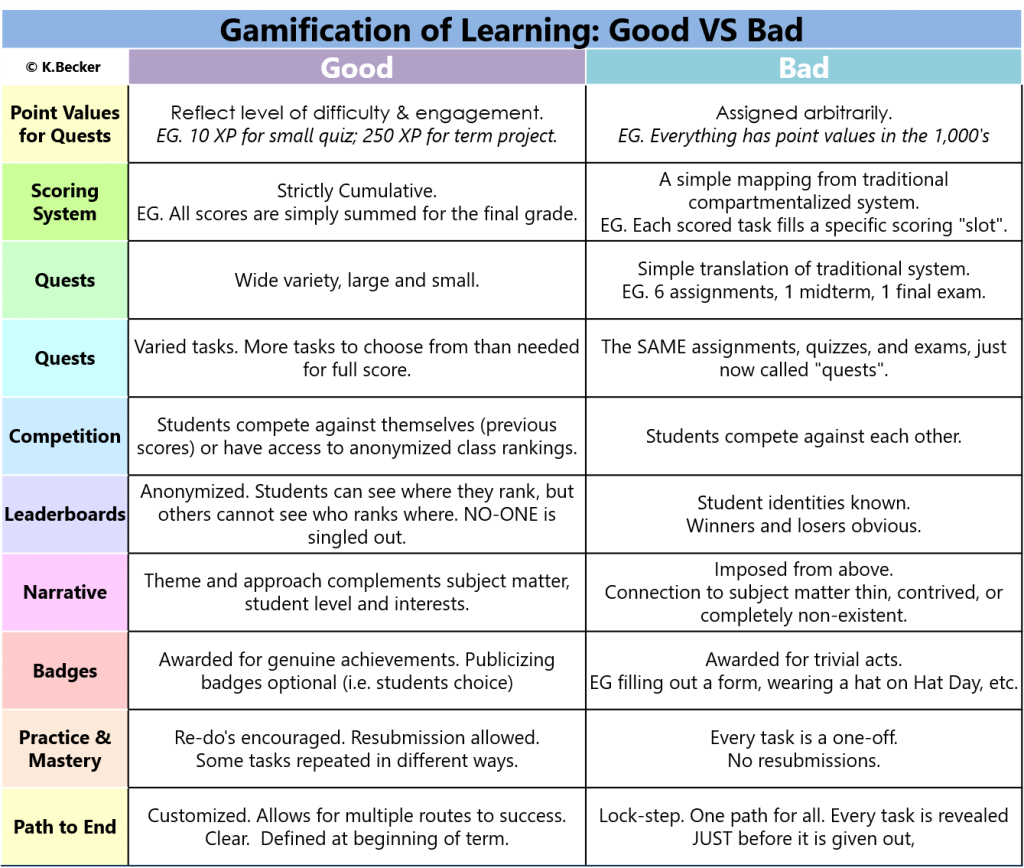
Here is Version 2.

 Be the first to like.

In this short commentary, Mieke Bal sets out her ten objections to the peer-review system in academic publishing.


 We have regained the rights to our 2011 book, The Guide to Computer Simulations and Games, originally published by Wiley.