• Skip to main content
  • Skip to secondary navigation

Mink Hollow Media

Democratizing Information Technology

  • About Us
    • Katrin Becker
  • Newest
  • In Development
  • Contact Us
  • Teaching & Learning
  • Games
  • Memoir
  • Programming
  • Science
  • Art
  • All Books

6: Randomness

Chapter 6

Here’s were we will put color versions of the images, updates, and other extras.

Random numbers are key to computer simulations and this section will help readers understand what they are, how computer-generated random numbers work and how they are used in simulations and games.

wordl-sim-book-ch-6

  1. What Does Randomness Mean?
  2. Randomness in games: dice, cards
  3. Generating Random Values
  4. Random events in real life: measuring randomness
  5. Simulating reality and intelligence
  6. Summary
    1. Concepts
    2. Terminology
  7. References, Notes & Further Resources

Images

*Please note: all images are copyrighted, permission to use an image must be obtained from Wiley (and possibly also the original sources).

Figure 6-1: The set of outcomes for the tossing of a pair of six-sided dice.
Figure 6-2: The complete set of outcomes for the toss of two coins.
Figure 6-3: Rand Corporation. 1955. A million random digits with 100,000 normal deviates, Glencoe, Ill., Free Press. Used with permission.
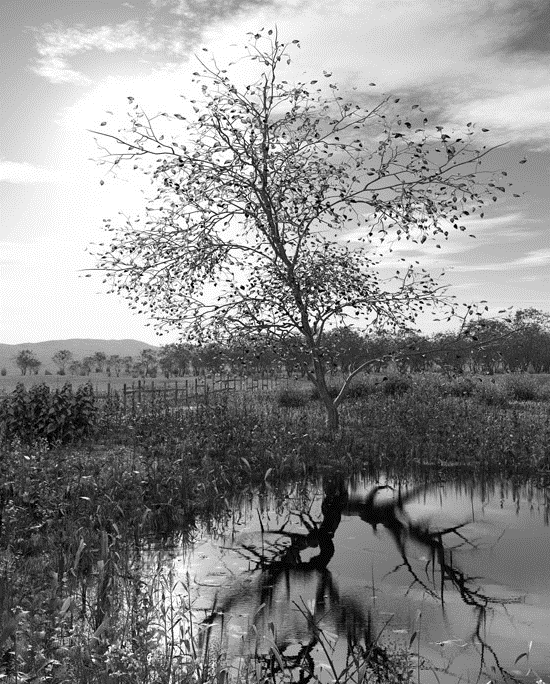
Figure 6-4: Trees and plants rendered by simulating plant growth from a seed.
Figure 6-4b Plants rendered using traditional graphics techniques.
Figure 6-5: A bus stop, an example of a system that can be simulated. The real system (above right) must be abstracted into a model (bottom) before a simulation can be created.

Copyright © 2026 · Author Pro on Genesis Framework · WordPress · Log in